
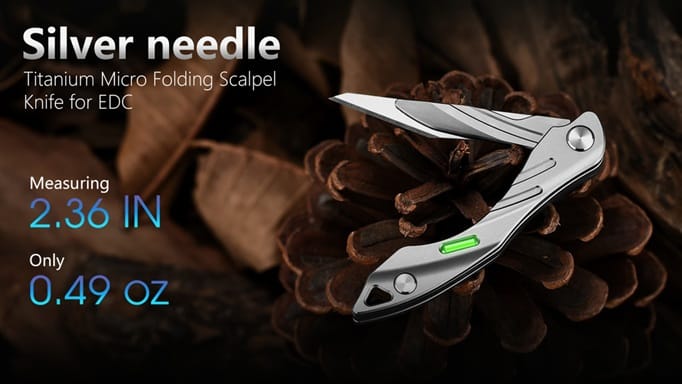
Titanium Folding Scalpel — Designed for portability with a focus on functionality, ready to carry with you anytime.
Check on Kickstarter
The Art of Design — “Silver Needle”
There are plenty of similar titanium alloy folding key knives on the market, which is precisely why making a true breakthrough in design aesthetics—turning it into something that looks like a work of art—is all the more challenging. The difficulty lies not only in the form itself; it takes tremendous effort to ensure smooth CNC machining and structural tuning while achieving a form that is visually compelling.
Our core goal in designing this titanium alloy folding key knife is to make it genuinely beautiful, something enduring to behold—a piece worthy of being regarded as art. It is with this pursuit in mind that we named it “Silver Needle.”
The beauty of “Silver Needle” lies in a highly integrated visual language: when closed, the design elements of the rotary handle and the main body flow into one another, seamlessly merging as a whole; when opened, every structural detail remains in dialogue with the others, forming a complete and coherent order. This sense of wholeness—born from a design logic sustained throughout—is something we believe only “Silver Needle” has achieved among all similar products currently available on the market.

Do you lack a knife?
I believe your answer is — no.
What you lack is “the knife you’d want to carry with you at all times.”
What kind of knife can be carried with us at all times and serve as a capable everyday tool? Not a tactical folder, and certainly not an outdoor survival knife—both of which, I believe, only get carried when you know you’ll need them. That means they won’t be there for the moments you don’t see coming.

“Silver Needle” — Our Optimal Solution, Truly Ready to Carry Anytime, Anywhere


These moments don’t deserve a knife you carry on purpose.
But they deserve a knife that’s there, on purpose, for you.


Zipper • No need to dig through your bag—just hang it on the zipper pull.✔
Keychain•Hang it with your house keys—carry it with you wherever you go.✔
Pocket•Quick to access, always within reach.✔
Necklace•Intimate and functional art.✔

Quick blade change.Dull? Swap in a fresh one.


A handful of silver needles, unlocking a myriad of blades.
What you hold is not just a silver blade, but a tool system built to accompany you for decades.
Machined from a single block of titanium alloy, it is crafted for a lifetime of use. Yet every edge grows weary in time—no need to discard the whole knife. In just three seconds, renew it with a fresh blade.
The silver needle is compatible with universally standard surgical blades: No. 11a, No. 11, No. 15c, No. 15. From unboxing packages to tooling leather, from cutting rope to scraping glue—four blade profiles, ready for every edge of your day.


Leave the heavy lifting to life.
Leave the light work to the silver needle.
With a 0.49 oz frame, a 2.36 in retracted blade, and rapid blade replacement, the silver needle is finally ready—for those small, everyday cutting tasks that always seem to wait on “the right tool.”


These moments don’t deserve a dedicated knife.
But they deserve a “silver needle”, right there when you need it.

Lightweight and portable, yet sharp and ready.
•The Silver Needle is designed for everyday carry, integrating into the fabric of your life with its minimalist design. With a newly added keychain hole, it can be hung on your keyring, attached to a bag zipper, or even worn as a pendant around your neck. More than just a tool, it is an elegant companion always within your reach.
•Infusing functional aesthetics into everyday carry. In addition to the portable keychain hole, it also features a reserved tritium slot—allowing you to install a tritium tube yourself, giving it a subtle glow in the dark. No need to rummage; with just a glance, you’ll always know where it is.

Please note—The Silver Needle does not include tritium vials, but they can be added as an additional bonus option. The default color is green.

TC4 Titanium Alloy — In your hand lies aerospace-grade reliability.

The handle of the Silver Needle is made exclusively from TC4 titanium alloy—the very material used in aircraft landing gear.
It’s not about showcasing expense, but about making one thing simple: you never have to handle it with care. No need to worry about rust, wear, or aging.
Milled from a single solid block of titanium, it has no laminates, no seams, and none of the joints that might “loosen after a few years.”

• Material: The Silver Needle is meticulously crafted from titanium alloy, ensuring both durability and lightweight performance. Its high strength-to-weight ratio makes it an ideal choice for everyday carry.
• Blade: Features a replaceable blade system for enhanced convenience and versatility, making it suitable for a wide variety of cutting tasks.
• Tritium Slot: Equipped with a dedicated tritium slot for adding glow-in-the-dark tritium vials. This feature enhances visibility and functionality in low-light conditions.
• Weight: Lightweight design, ideal for everyday practicality without compromising on strength.
• Dimensions: Compact in size and highly portable, making it an indispensable tool for outdoor activities, daily tasks, or emergency situations.

The soul in the sketch
The starting point of design has never been a computer screen, but a blank sheet of paper and a pen.
The initial sketches were chaotic and free. The designer repeatedly traced the same question: How can a folding knife present a complete formal order both when closed and when opened? On the draft paper, the curves of the pivot and the contours of the handle intersected, overlapped, and separated over and over again—until, at a certain moment, a single line connected both. For the first time, a unified visual language emerged on the paper.At that moment, the “soul” of the Silver Needle was born.

The leap from two dimensions to three dimensions
After the sketch set the tone, the project moved into the 3D modeling stage. This was the transformation from “feeling” to “data.”
In the modeling software, the designer transformed the hand-drawn lines into precise curves, then extruded, revolved, and cut them into solid forms. The relationship between the pivot and the handle was meticulously refined: when closed, they had to align perfectly; when open, they could not interfere with each other. Every surface, every chamfer was re-examined in three-dimensional space.At this stage, the “feeling” from the sketch began to take on a “form.”

Structure validation and CNC simulation
Once the form was established, the real challenge began: Could it actually be manufactured?
The 3D model was imported into the CAM software to simulate the actual CNC machining process. Tool paths traced across the screen; each pass signified material being removed, and with it, the potential for error. The designer watched intently, checking whether the tool could reach every corner, if the wall thickness was sufficient to ensure strength, and whether the structure might deform after cutting.
Some surfaces were too steep for the tool to access—those were revised. Some corners were too sharp, risking stress concentration—those were adjusted. The romance of the sketch had to withstand the reality of the cut.


