
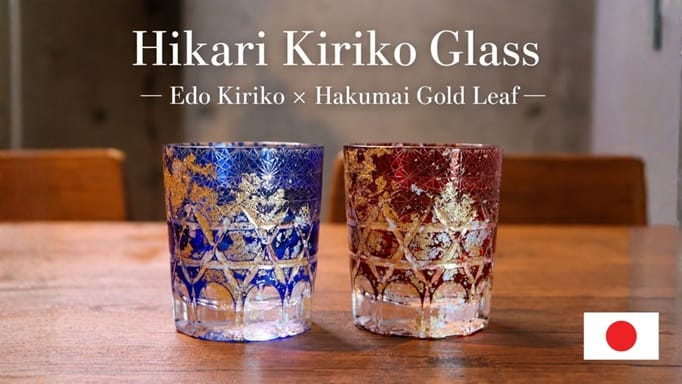
A handcrafted glass that reflects light beautifully and elevates your everyday drink experience
Check on Kickstarter


Experience Light
in Layers
Experience Light in Layers A handcrafted Edo Kiriko glass adorned with real gold and silver leaf — through the Hakumai technique


You’ve curated the whisky. You’ve dimmed the lights. You’ve chosen the music. But the glass in your hand — generic, inert, invisible — adds nothing to the moment.
Most glassware is engineered for function alone: hold liquid, don’t break, stack cleanly. It has no story. No presence. No light.
The result is an experience that falls short of what you were reaching for — something quieter, slower, more intentional.

The glass that touches your lips should be as considered as everything else in the room. It should catch light. Tell a story. Reward a second look.

Edo Kiriko is the ancient Japanese art of cutting geometric patterns into glass to split and scatter light. Hakumai is a proprietary gold and silver leaf technique, developed by master craftsman Yoshihiko Fujii of Nuri Koubou Fujii — a lacquer atelier rooted in Kuroe, one of Japan’s three great lacquerware traditions.
No one has combined them. Until now.
The Nuri Kobo Fujii glass fuses both crafts into a single drinking object — one that creates layered light reflections, metallic diffusion, and depth of color that transforms with every pour, every lamp, every angle of evening light.

The geometric cuts refract your drink’s colour. The gold and silver leaf catch and redirect ambient light. The result changes every time you move the glass.

The Kiriko cuts are not merely decorative. Each geometric facet is a precision prism. Ambient light enters from every angle, fragments, and rebounds — creating an internal luminosity that shifts as you tilt the glass, as the liquid level drops, as the candle moves.
Pour a single malt. Watch the amber multiply across the cut facets. Add ice. Watch the refraction shift. The glass actively participates in the drink.
Genuine Gold. Genuine Silver. No Compromise.

The Hakumai decoration on this glass uses real gold leaf and real silver leaf — not metallic paint, not foil transfer, not printed metallic ink.
These are the same materials Japanese lacquer masters have used for over a thousand years. Applied by hand, particle by particle, using traditional urushi lacquer as the binding medium. The result is a decoration with true optical weight — it catches light differently than any synthetic surface can.
Built to Be Used, Not Just Admired

Traditional lacquerware cannot withstand water immersion — it clouds, lifts, and cracks. This was the fundamental barrier preventing gold leaf from ever appearing on functional drinking vessels. We solved it.
A proprietary backside coating and multi-layer protective finish seal and stabilise the gold and silver decoration. The result: a glass that survives dishwasher cycles without degradation and resists the moisture, oils, and temperature shifts of daily use.
Designed for the Hand That Holds It Every Evening
Beauty without usability is decoration. This glass is proportioned to feel natural in a relaxed hand — a grip diameter calibrated for comfort, a weighted base that doesn’t tip, and a 280ml capacity that suits whisky, sake, and spirit-forward cocktails equally well.
The Kiriko cuts also create natural tactile feedback — your fingers find the facets intuitively. The glass tells you where to hold it.

Geometry You Can See. Brilliance You Can Feel
Each Edo Kiriko pattern is cut by hand using traditional grinding wheels. There is no laser, no CNC, no moulds. The artisan’s angle, pressure, and timing determine every facet.
After cutting, each piece is hand-polished to optical clarity — a process that takes hours per glass and cannot be rushed. This is why Kiriko has never been mass-produced. And why each piece carries a quality that a machine cannot replicate.

Two Traditions. One Modern Form.
Edo Kiriko — 1834

Originating in Edo (now Tokyo), Kiriko glass cutting developed as craftsmen adapted European wheel-cutting techniques to Japanese aesthetic values.
The hallmark is precise geometric patterning — chrysanthemums, hemp leaves, fish scales — that fractures and amplifies ambient light.
Hakumai (箔舞)— The Art of Dancing Gold Leaf

Hakumai (箔舞) is a proprietary gold and silver leaf technique developed by Yoshihiko Fujii, the master craftsman behind Nuri Koubou Fujii.
Born from the 400-year lacquerware tradition of Kuroe, Wakayama — one of Japan’s three great lacquerware production centers — Hakumai applies real gold and silver leaf directly onto cut glass through a multi-layer bonding and coating process, unique to this atelier.

Unlike conventional gold painting, which appears flat and yellowed, Hakumai captures the true luminosity of real leaf. The gold shifts and dances with light and angle — warm, alive, and impossible to replicate.
It is not merely decoration. It is a discipline that took twenty years to perfect.
The Fusion — Today

Two traditions. One object. One impossible problem — solved.
Edo Kiriko, developed in the 19th century, is the art of cutting precise geometric patterns into glass — designed to capture and refract light. Hakumai, developed by Nuri Koubou Fujii over two decades, applies real gold and silver leaf to glass to create depth and luminosity.

For centuries, these two crafts existed in parallel — and in silence. The barrier was simple and absolute: gold leaf on glass cannot survive water. Traditional lacquer clouds, lifts, and fails at the first wash. This meant Hakumai-style decoration had never appeared on a functional drinking vessel. Anywhere. Ever.
Yoshihiko Fujii spent years developing a proprietary multi-layer bonding and protective coating system — engineered specifically to solve this problem. The gold and silver are now sealed, stabilised, and protected. Dishwasher-safe. Built for daily use. Built to outlast you.
Not an object to be preserved behind glass. An object to hold every evening.
As light passes through the Kiriko cuts and reflects off the Hakumai gold leaf, the glass transforms with every angle, every pour, every moment. This is not simply a fusion of techniques. It is a new category of object that did not exist before 2025.


Whisky Night
The 280ml capacity is ideal for a generous measure with a single large ice sphere. The Kiriko cuts refract the amber through the crystal — the glass becomes part of the nosing experience.

Sake Ritual
Serve premium ginjo-shu chilled. The Hakumai gold catches candlelight. The geometric cuts catch the sake’s faint luminosity. The vessel elevates the occasion from simple drinking to ceremony.

Cocktail Presentation
A Negroni, an Old Fashioned, a spirit-forward stirred cocktail. The glass gives the presentation an authority that no standard rocks glass can match.

Interior Display
Empty, lit from behind or below, the glass is a sculptural object. Placed on a shelf, a bar cart, or a coffee table, it functions as a collectible design piece.

Luxury Gifting
Each glass arrives in artisan packaging with its story. For the person who has everything. For the collector who values the unrepeatable. For any occasion that deserves permanence.

The Object, Precisely

Rewards

The Master Behind the Gold — Yoshihiko Fujii

Yoshihiko Fujii was born in Kuroe, Wakayama — a town that has produced lacquerware for over 400 years. He grew up surrounded by the craft, left to see the world, returned, and spent the next two decades asking one question: what has lacquer never been able to do?

In 2001, he founded Nuri Koubou Fujii with a single conviction: tradition only survives if it evolves. He developed new techniques. He applied lacquer to materials it had never touched. He refused to make objects that already existed.

The Hakumai technique — applying real gold and silver leaf to cut glass through a bonding system he engineered himself — is the culmination of that work.
He makes each piece alone, by hand, in a precision clean room he built in his workshop. There is no production line. There is no team. There is one craftsman, one atelier, and twenty years of accumulated mastery.
Every glass that leaves Nuri Koubou Fujii bears his hands.
Designed by Kagami

The aesthetic vision of this glass comes from Kagami (鏡), a Japanese creative design collective whose name means “Mirror.”
Kagami was founded on a single obsession: how does traditional Japanese craftsmanship interact with light? Every cut, every angle, every layer of gold leaf is conceived around one question — what happens when light touches this object?
They believe Japanese craft doesn’t live in the object alone. It lives in the moment light finds it. Hikari exists to be a guiding light for tradition — bringing ancient techniques into a world that has never seen them this way.
Every Concern,
Addressed Honestly
Can I use this every day, or is it only decorative?
It is designed for daily use. The multi-layer protective coating and proprietary barrier system allow the glass to withstand normal domestic use, including dishwasher cycles. This was the central engineering challenge of the project — we solved it before launching.
Will the gold and silver decoration fade over time?
The Hakumai decoration is sealed beneath a hard protective clear coat that resists moisture, oils, and temperature variation. Unlike painted metallic finishes, the gold and silver leaf are bound in urushi lacquer — a medium that becomes harder and more stable over decades, not more fragile.
Is this fragile? Will it break easily?
Edo Kiriko glass is cut from thick optical glass — it is not thin or delicate. This is a substantial, weighted object with a stable base. It is not immune to drops on hard floors, but it is not a precious object to be handled with anxiety. It is meant to be picked up, poured into, and enjoyed.
Is it comfortable to hold for long periods?
The grip diameter and weight distribution were tested specifically for a relaxed hand over an extended evening session. The Kiriko facets provide natural non-slip texture. Most backers in our testing reported it felt more secure than a smooth glass, not less.
What makes this worth the price?
You are acquiring an object that required the mastery of two ancient craft traditions, the development of a proprietary protective system, and the hands-on work of a twenty-year master artisan. No two pieces are identical. This is not a product. It is a made object. The price reflects the irreducible cost of genuine human skill and authentic materials.
How is international shipping handled?
Each glass is shipped in a custom artisan box with multi-layer internal protection — rigid foam, tissue wrapping, and a sealed outer carton. The packaging is designed to survive the rigours of international courier handling. All international shipments are insured and tracked from Kuroe to your door.
What is the difference between this and standard Kiriko?
Standard Edo Kiriko is already a premium craft object. This glass adds a layer of Hakumai gold leaf decoration using real gold and silver — a combination that has never existed before in functional glassware. You are not buying upgraded Kiriko. You are buying a new category of object.
Shipping


