
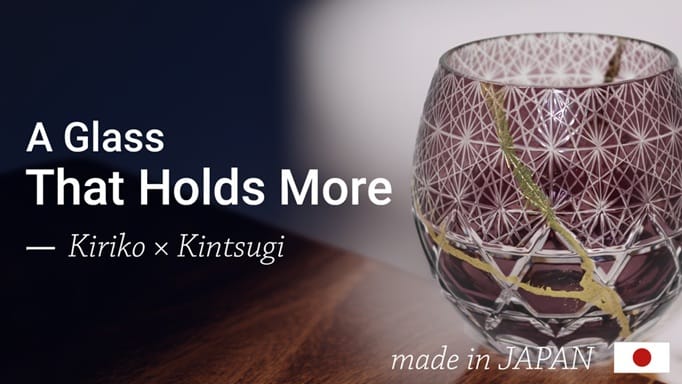
A handcrafted glass designed to be used every day — bringing beauty, weight, and presence to every drink
Check on Kickstarter

More volume. More stories. More meaning.
Most beautiful objects ask you not to touch them.
This one asks you to reach for it every day.
The Kintsugi Glass is a large-format, wide-body Kiriko zaiku cut glass — handcrafted by Japanese artisans, finished with gold lines inspired by the ancient philosophy of kintsugi. It is, at once, a work of art and the glass you’ll want in your hand every evening.

—
MORE THAN A GLASS
We didn’t design a display piece. We designed a companion.

There’s a certain kind of beautiful object that ends up behind glass — admired, untouched, waiting for a “special occasion” that never quite arrives.
We wanted something different.
The Kintsugi Glass was designed from the start to be used. Its larger, wider form isn’t just a visual choice — it’s a functional one. More volume means more versatility. More presence means more pleasure, every time you pick it up.
This is the glass you pour your whiskey into after a long day. The one you fill with iced tea on a Sunday morning. The one your guests notice the moment they sit down.
Kiriko zaiku precision. Kintsugi philosophy. A form made for daily life.
—
THE BEAUTY OF IMPERFECTION
Kintsugi: The Art of Repair

Centuries ago, Japanese craftspeople developed a practice of repairing broken ceramics with lacquer mixed with gold. Rather than hiding the damage, they illuminated it — transforming fractures into features, scars into beauty.
The philosophy behind kintsugi is simple and profound: what has been broken is not diminished. It is made more interesting.

In a world that discards what is flawed and chases what is flawless, kintsugi offers a quieter, older idea — that history, resilience, and imperfection are not things to conceal. They are things to celebrate.
The gold lines on this glass are not decorations. They are a reminder.
A reminder that the most meaningful things in life are rarely perfect —
and that’s exactly what makes them worth holding onto.
—
NOT JUST ART — MADE FOR DAILY USE
Beautiful objects should be touched.

Where traditional artisan glasses are often small, delicate, and best suited to occasional use, this glass was made to be reached for. Its wide, open form accommodates ice, garnishes, layered drinks, and generous pours. Its substantial weight feels grounded and intentional in the hand — not fragile, not precious, but *present*.
This is a glass that improves the ritual of whatever you’re drinking.
—
VERSATILITY — ONE GLASS, MANY MOMENTS
The glass that adapts to your day.
We designed the Kintsugi Glass to move with you — from morning to evening, from dining table to home bar.
Whiskey & Spirits

The wide mouth opens the aroma. The weight anchors the experience. Whether it’s a single malt at the end of the day or a mezcal with a twist, this glass makes it a ritual.
Cocktails

Large enough for ice, garnishes, and complex builds. The Kiriko zaiku cuts catch the light in a way that makes every drink look intentional.
Water, Tea & Soft Drinks

There’s no reason your glass of iced tea shouldn’t be beautiful. The Kintsugi Glass makes even the simplest drink feel considered.
Desserts & Creative Plating

Use it for parfait, mousse, tiramisu, or fruit. The wide form and striking silhouette make it a natural vessel for plated desserts that deserve to be seen.
Table Presentations
For hosting, entertaining, or simply setting a table that reflects your taste — this glass is a conversation starter before a word is spoken.

—
6. PRODUCT DETAILS
The Kintsugi Glass


A large-format, wide-body Kiriko zaiku cut glass with kintsugi-inspired gold detailing. Hand-finished in Japan. Small-batch production.

The glass is weighted for stability and balanced for comfort — substantial enough to feel luxurious, refined enough to feel effortless.
—
WHY THIS IS DIFFERENT
Not decorative. Not mass-produced. Not an imitation.
The market is full of “kintsugi-inspired” products. Most are printed patterns on factory glass, designed to evoke a philosophy rather than embody it.
The Kintsugi Glass is different in three ways:
It is genuinely handcrafted.
Kiriko zaiku is a demanding traditional technique. Each glass is finished by hand by artisans who have trained for years. No two pieces are identical.
It is larger than most craft glass.
The majority of artisan glassware is small — beautiful, but limited. This glass was intentionally designed with a wider, more generous form so that it transitions seamlessly from display to daily use.
It is made to be used.
The gold detailing is applied with durability in mind — not painted on, but carefully integrated into the finish. This is not a glass you admire from a distance. It is a glass you use, wash, and reach for again tomorrow.

—
CRAFTSMANSHIP — HOW IT IS MADE
Kiriko Zaiku: The Art of the Cut

Kiriko zaiku is one of Japan’s most celebrated glassworking traditions. Developed in the early 19th century, it involves cutting precise geometric patterns into glass by hand — a process that requires exceptional skill, patience, and an intimate understanding of the material.
Each cut is made individually. There is no template, no shortcut, no automation. The patterns that emerge — their depth, their angles, their relationship to light — are the result of a craftsperson’s hands and judgment, accumulated over thousands of hours of practice.
The result is glass that does something ordinary glass cannot: it catches light from multiple directions simultaneously, creating an interior shimmer that changes as you move, as the light changes, as the day progresses.
The Kintsugi Gold

The gold detailing on this glass is not a printed pattern or a surface transfer. It is hand-applied by artisans trained in lacquerwork and kintsugi technique — the same tradition used to repair ceramics with gold at Nuri Koubou’s studio.
The lines follow the geometry of the Kiriko zaiku cuts, as though the glass itself has been repaired — made whole, and made golden, in the Japanese tradition.
Maki-e: The Gold That Comes From Within

The gold detailing on the Kintsugi Glass draws on one of Japan’s most refined decorative arts: maki-e, a technique in which gold and silver powders are delicately applied to a lacquered surface before it sets — then polished to reveal a luminous, deeply embedded finish.
Unlike surface printing or plating, maki-e gold is worked into the material itself. The result is a warmth and depth that cannot be replicated by mechanical means — a glow that seems to come from within the object, rather than sitting on top of it.
Developed over a thousand years ago and long associated with the finest Japanese craftsmanship, maki-e has traditionally adorned lacquerware, samurai armor, and ceremonial objects. Its application to the Kintsugi Glass represents a rare translation of this heritage into a new form — one designed not for ceremony, but for the everyday.
This is not decoration. This is craft with a thousand-year lineage, held in your hand.
—
ABOUT THE MAKER — NURI KOUBOU
Nuri Koubou is a Japanese atelier dedicated to the crafts of lacquerwork and kintsugi. Founded on the belief that what is broken is not without value, the studio has spent years refining its practice — repairing ceramic objects, teaching the art of kintsugi, and exploring the philosophy of imperfection as a form of beauty.

The Kintsugi Glass represents a natural expansion of that philosophy — from repair to creation, from ceramics to glass. It is the studio’s first foray into cut glassware, and an expression of what kintsugi means when it becomes not a response to damage, but an intention from the start.

—
ABOUT “KINTSUGI”
Bringing Japanese craftsmanship to the world.

Kintsugi is more than a technique — it is a way of seeing.
Inspired by the Japanese art of repairing broken objects with gold, we create products that celebrate imperfection, resilience, and transformation.
Through collaborations with Japanese artisans, we bring traditional craftsmanship into modern life.
Our first project combines Kintsugi with Edo Kiriko glass, redefining how beauty can be restored and reimagined.
—
QUALITY & DURABILITY
Made to last. Designed to be used.

We understand the concern. Gold detailing. Handcrafted glass. It sounds like something you’re afraid to put in the sink.
Here’s the reality: the Kintsugi Glass was designed with daily use in mind from the beginning. The gold detailing is carefully applied and finished to withstand regular handling. The glass itself is produced to the standards expected of premium Japanese craft tableware — substantial, considered, and built to accompany you for years, not occasions.
The Kintsugi Glass is dishwasher safe. The maki-e gold detailing has been finished and sealed to withstand machine washing without loss of colour, adhesion, or luminosity. That said, as with any handcrafted object of quality, hand washing is recommended for long-term care — it takes thirty seconds and adds years to the life of the finish.
Care guidance:
Hand washing is recommended to preserve the gold detailing and the brilliance of the Kiriko zaiku cuts over time. Avoid abrasive cloths. Handle with the same care you would give any quality glass — which is to say, normal care, not ceremonial caution.
With proper handling, this glass will look as beautiful in ten years as it does the day it arrives.
—
SIZE & ERGONOMICS
Larger by design. Not larger by accident.
The wider form means your hand wraps around it naturally. The additional volume means you’re not constantly refilling. The generous opening means aromas aren’t trapped — whether you’re drinking whiskey, tea, or something in between.
It is heavy enough to feel considered. Light enough to hold for an evening. Stable enough to set down without thinking about it.
This is what size feels like when it’s purposeful.
—
REWARDS


